
Last Updated on :
Saturday, November 22, 2014
- Information
- Articles Books Booklets
- Commentaries
- Daily Readings
- Hymns/Music
- Study Aids
- Basis of Belief
- Doctrines we reject
- Commandments of Christ
- Christadelphian Instructor
- Sisters
- Read it in a year
- Downloads PDF/Word
- Mobile Files Old Home Page
- _____

___
The Coming Anti-Christ: Jesus of Nazareth?
A Tragic Case of Mistaken Identity?
A Study of A Key Prophecy
Daniel's Prophecy of the Seventy Weeks
Part 2
The remarkable evidence in Part I points strongly to the conclusion that a tragic case of mistaken identity will soon unfold. This appears inevitable in view of the widespread expectation that an evil despot, seeking world domination, is about to appear in Jerusalem; for his anticipated aims and work fit with astonishing similarity the prophecies concerning the future mission of Christ when he returns to the earth to set up His universal empire (Psalm 72:8; Daniel 2:44). That Christ should be confused with an imaginary evil dictator, the Antichrist, is a great tragedy-yet does it not seem bound to happen?
The inquisitive reader cannot be satisfied to let the matter rest here. Who is the author of this confusion? Is it from the Bible that many have been led to expect the appearance of Antichrist? Although this teaching is imputed to the Bible, few are they who can point to scriptures in support of the idea. It is needful, therefore, that an effort be made to acquaint the reader with that segment of Bible prophecy that provides the foundation for the whole concept of the coming Antichrist. The basis is a famous prophecy given to Daniel, commonly known as "The Prophecy of the Seventy Weeks", because its fulfillment spans a seventy week time period. Although this prophecy is not the only one from which believers in the Antichrist theory draw their expectations, it is fair to say that it is the key by which the other prophecies are interpreted and their meaning discerned. It follows, therefore, that the soundness of the Antichrist idea stands or falls with the correctness of the interpretation of this prophecy. Before showing how this prophecy has been understood to teach the concept of the coming Antichrist, it is first advisable to carefully examine the prophecy, discern the general features of the events described and search for their fulfillment in history. The exposition is not simple, but careful consideration of the following pages may well convince the reader of the wisdom of God in revealing to Daniel much information concerning Messiah the Prince. The prophecy is found in Daniel 9:23-27:
At the beginning of thy supplications the commandment came forth, and I am come to show thee; for thou art greatly beloved: therefore understand the matter, and consider the vision. Seventy weeks are determined upon thy people and upon thy holy city, to finish the transgression, and to make an end of sins, and to make reconciliation for iniquity, and to bring in everlasting righteousness, and to seal up the vision and prophecy, and anoint the most Holy. Know therefore and understand, that from the going forth of the commandment to restore and to build Jerusalem unto the Messiah the Prince shall be seven weeks, and threescore and two weeks: the street shall be built again, and the wall, even in troublous times. And after threescore and two weeks shall Messiah be cut off, but not for himself: and the people of the prince that shall come shall destroy the city and the sanctuary; and the end thereof shall be with a flood, and unto the end of the war desolations are determined. And he shall confirm the covenant with many for one week: and in the midst of the week he shall cause the sacrifice and the oblation to cease, and for the overspreading of abominations he shall make it desolate, even until the consummation, and that determined shall be poured upon the desolate.
Notice that the prophecy expressly identifies the title of the man with whom it is chiefly concerned-Messiah the Prince. Even if the prophecy does refer to Antichrist, any possible allusion to him must be completely overshadowed by the description of Messiah the Prince, for the prophecy relates both to the time of Messiah's coming and to the nature of the work he would do. In this exposition we shall consider each of these details in turn. Throughout the discussion that follows, the reader should be encouraged to ask himself if Antichrist, as popularly conceived, is mentioned at all in the prophecy.
The Time Period Spanned By The Seventy Weeks
In considering the time period spanned by the prophecy,
It is necessary to settle three things: first, the starting point; second, the actual measurement of time cryptically revealed as "seventy weeks"; third, the ending point. Any two of these times are sufficient to establish the third.
The information concerning the starting point is disclosed by the prophet: From the going forth of the commandment to restore and to build Jerusalem. At the time the prophecy was revealed to Daniel, he and his people were captives in Babylon, and the land of his nativity was occupied by foreigners. The temple and Jerusalem itself had been laid in ruins. The period of time prophetically indicated as "seventy weeks" was to begin when a commandment was given permitting the captive Jews to return to Jerusalem and undertake its restoration. If we can determine which commandment this was, and the year in which it was given, we shall have learned when the time period began. The problem is that the Bible records four different decrees, all of which bear examination, and are set out in the diagram below.
DIAGRAM #1 (larger version) : The Four Decrees of the Persian Kings
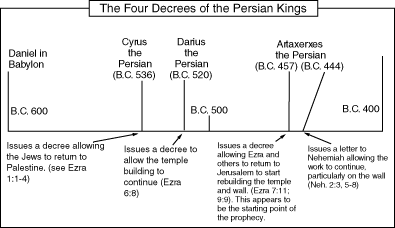
There is no obvious reason for choosing one of these decrees over the others. But one is constrained by the requirements of the case. Seventy weeks were to elapse from the giving of the decree until Messiah the Prince's work was complete. On this basis, as shall be shown, it is the third decree that appears to be the starting point for the prophecy. The Bible's record of this decree is set out in Ezra 7:11-13.
Now this is the copy of the letter that the king Artaxerxes gave unto Ezra the priest, the scribe, even a scribe of the words of the commandments of the LORD, and of his statutes to Israel. Artaxerxes, king of kings, unto Ezra the priest, a scribe of the law of the Cod of heaven, perfect peace, and at such a time. I make a decree, that all they of the people of Israel, and of his priests and Levites, in my realm, which are minded of their own freewill to go up to Jerusalem, go with thee.
Some thirteen years later, the same Persian monarch issued a second decree, in the form of a letter given to Nehemiah. (This decree is the fourth decree on the diagram.) It would appear that Nehemiah's work towards the restoration of Jerusalem was only a continuation of the work originally begun by Ezra, for it is evident that they laboured together for a time (See Nehemiah 8:9). This is one reason for concluding that the initial decree of Artaxerxes in 457 B.C. is the one intended by the prophecy, although admittedly a case can be made for his decree of 444 B.C. In this respect, it is interesting to note that calculations using both decrees expire at approximately the same time, if different measures of years are used. In the East where Daniel was living it was more common to measure years by the number of revolutions of the moon, twelve complete cycles of the moon being taken as one year. These years are termed "lunar years" in contrast to our more familiar "solar year" which is one complete revolution of the earth about the sun. The lunar year is about eleven days shorter than the solar year. Measuring "seventy weeks" from 457 B.C. in solar years or from 444 B.C. in lunar years results in approximately the same terminus. This point is mentioned to draw the reader's attention to the fact that this exposition is not seriously affected by the choice of starting point, as both the third decree, measuring "seventy weeks" in solar years, and the fourth decree, measuring the time span in lunar years, yield approximately the same ending point. Although it is not possible to decisively choose one decree above another as the starting point, the strongest case, in the writers' view, can be made for the third decree of 457 B.C.
It is now time to settle the second detail. What period of time is actually indicated by the prophetic measure of "seventy weeks"? There is universal agreement that seventy literal weeks are not intended, for this would be a period of time little more than one year. This leads us to a consideration of an essential principle of prophetic interpretation and a striking characteristic of prophetic revelation. In prophecy, a day is used to represent a time interval whose actual fulfillment will be one year (See Numbers 14:34, Ezekiel 4:6) Why should this be? The answer is that God has chosen symbols that represent in miniature things that are to happen on the earth. For example, two wild animals fighting represent the overthrow of one kingdom by another. Likewise, there has been a corresponding need to miniaturize the time associated with the event, so that it is in keeping with the character of the symbol employed. Beasts might fight for days but not for years-so that when, in prophecy, beasts symbolically enact the roles that kings and nations will later fulfil, the time associated with their activity must be expressed on a reduced scale in order to maintain the internal consistency of the revelation. Where measurements of time are involved, the key is that each day on the miniature prophetic scale represents one year of actual time when the prophecy is worked out in history. On this well established basis, the "seventy weeks" time span, comprising four hundred ninety days, corresponds to four hundred ninety years of actual time.
We are now in a position to settle the third detail concerning the time span of the prophecy-its expiry date. From Daniel 9:25 it is clear that sixty nine weeks were to elapse from the going forth of the commandment until Messiah the Prince. But what is intended by this phrase "Messiah the Prince"? Does it refer to the time of his birth or some other time? The answer to this question lies in the meaning of the term "Messiah". It simply means anointed. Jesus therefore did not become the Messiah until the time of his anointing, and this certainly did not occur at his birth. The record of his anointing is contained in Matthew 3:16-17:
And Jesus, when he was baptized, went up straightway out of the water: and lo, the heavens were opened unto him, and he saw the Spirit of God descending like a dove, and lighting upon him: And lo, a voice from heaven, saying, This is my beloved Son, in whom I am well pleased. This was the incident in the life of Jesus by which he was manifested to Israel. And I (John the Baptist) knew him (Jesus) not: but that he should be made manifest to Israel, therefore am I come baptizing with water (John 1:31)
And, it is shown in Acts 10:38, that it was at his baptism, when he received the Holy Spirit without measure, that he became the Anointed of God. How God anointed Jesus of Nazareth with the Holy Spirit and with power: who went about doing good, and healing all that were possessed with the devil; for God was with him. By the phrase, "unto Messiah the Prince" is intended, therefore, the time to the baptism of Jesus, for it was not until this time that he was anointed by God, and thereafter assumed the title of Messiah.
Sixty nine weeks represent four hundred eighty-three days, which, as we have shown earlier in this exposition, represent four hundred eighty three years of actual time. Adding this time to 457 B.C., when the commandment to restore Jerusalem was given, brings us to the year A.D. 27. Was this the year in which Jesus was baptized by John? It is recorded by Luke that at the time of his baptism, Jesus was about thirty years of age (Luke 3:23) However, it is generally recognized that Jesus was born in approximately 4 B.C., in which case he would be exactly thirty years of age in A.D. 27. (When the B.C.--A.D. calendar was formulated, the birth of Christ was misplaced by about four years. This explains why Jesus was not thirty years old in A.D. 30.) Thus it was about A.D. 27 when Jesus was baptized, that year being exactly sixty nine weeks or four hundred eighty three years from the first decree of Artaxerxes.
The three details concerning the first sixty nine weeks of the prophecy have now been settled--the starting date was the decree of Artaxerxes in 457 B.C.; the time span was four hundred eighty three years; and the ending point was the baptism and anointing of Jesus in A.D. 27. It was noted at the outset that any two of these three details would be sufficient to establish the third. Notwithstanding the fact that an effort has been made to verify all three, it must be admitted that the main reason for choosing the third decree as the starting point--and it is the starting point that is the most difficult to fix--is that it fits in with the other two remarkably well. The following diagram, which summarizes the prophecy, adds the seventieth and final week to the sixty nine, for it is the events of this week that shall largely concern us for the balance of this exposition.
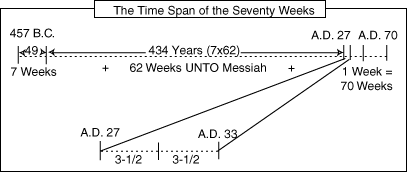
Before leaving the subject of the time spanned by the prophecy, it is worth our time to consider whether or not the prophecy had any effect on the people in the time of Christ. Four different sources indicate that the world at large was expecting Messiah to appear at that time.
The first source is the Bible itself. And as the people were in expectation, and all men mused in their hearts of John, whether he were the Christ (the Messiah) or not (Luke 3: 15).
The Jewish historian Josephus is the second source. Writing of this general time, within forty years of the death of Christ at the time of the Jewish wars, he notes:
"That which did especially inspire them (the Jews) to undertake this war was an ambiguous oracle likewise found in their sacred writings, how that some one of their own country, pertaining to that time, should attain the empire of the habitable earth.(1)
The Jews took their Scriptures with them as they spread throughout the Mediterranean world and two Romans, one an historian and the other a biographer, record an opinion similar to that of Josephus. It is probable they developed this expectation as a result of their contact with Jews. Referring to the time of the Jewish war, in A.D. 66 to 70, they wrote:
"A few turned these events into a cause for alarm; the greater number were possessed with a belief that it was written in the ancient writings of the priests that it would come to pass at that very time, that the East would grow mighty, and that men proceeding from Judea would gain the empire of the world(2)
"A firm persuasion had long prevailed through all the East, that it was fated (i.e. contained in the Book of Fates or prophecies) at that time for the Empire of the World to devolve upon some one who should come forth from Judea."(3)
These four sources show that there was an expectation of a Jewish Deliverer either coincident with or shortly after the appearance of Christ, and while none of them expressly trace this idea to the prophecy of the Seventy Weeks, it is apparently the source from which it was derived. One is led to conclude that the prophecy did have a noticeable effect on the world at that time.
All Books/Booklets, Editorials, and Articles are FREE and can be downloaded without permission.